Artificial intelligence, or AI, is everywhere. You can hardly browse the internet or check the daily news cycle without hearing or seeing something about AI. In the past two years, there’s been a meteoric rise in AI chatbots, too—and unsurprisingly, there has been a corresponding rise in AI chatbot usage. The average website, email write-up, workplace performance appraisal, and text message now has some degree of AI influence. This is not a bad thing, per se, as AI usage can improve clarity, communication, and speed in numerous activities. Therefore, today’s blog is not set to condemn AI in general or suggest that “the robots are taking over” in some panicked, conspiratorial way. Instead, it is meant to make a serious argument that, within Christian ministry, AI must have limited and transparent usage.
While we don’t like to think of the Bible this way, in addition to revealing Jesus Christ, it is highly concerned with morality and ethics, as these concepts correspond to the holiness of God. Related to AI, the question must be raised: “Is the use of AI wrong?” For something to be considered biblically wrong, we either need an explicit instruction in the Bible, a principle rightly drawn out from Scripture, or a sufficient collection of biblical ideas to guide an individual. Since I’ve already stated that AI is not “a bad thing, per se,” I think it’s best to limit the scope to Christians within a ministry.
Intellectual Dishonesty
First, the Bible says, “You shall not steal” and decries theft (Ex. 20:15, Rom. 13:9, Eph. 4:28). While we most often think of theft in terms of tangible items, the concept is applicable to intellectual property as well. With regard to intangible things, giving proper credit is usually the means of avoiding plagiarism (theft of written or spoken thought) while altogether avoiding use of things that would violate state-enforced law. Side note: There’s a sense in which AI, generally speaking, steals intellectual and artistic property all the time, but I digress.
More specifically, regarding preaching and AI, there is a clear problem. Namely, the whole of church history has assumed the preacher, through the power of the Holy Spirit, is the architect of his own sermon. Anything that’s not his own ideas or biblical text is meant to be credited to another, and congregations assume this from the outset. Failing to share this information, especially when using AI for substantial assistance, is flatly dishonest.
Human Agency
Second, God uses people as His foremost means of sharing the truth and the Gospel with a fallen world (Matt. 28:19; Phil. 2:13). While those human beings are permitted to use various tools, those tools should never replace human agency (2 Cor. 4:7), and when they do, problems arise.
Moreover, God uses His word to save men and accomplish His purposes, and AI can certainly use God’s word as a tool. However, the issue boils down to the means. AI chatbots don’t use “thought” in the human sense. An AI chatbot generates responses using a complex language model that’s trained to recognize patterns, and it responds to those prompts using what it has learned. Thus, it lacks a soul and the human reasoning, to include weaknesses and errors, that God desires to use.
AI with Limits
As a final point, AI is not the means God has chosen to accomplish His will; He uses fallen men for His good pleasure (1 Cor. 1:27). So, how should AI be used in a limited fashion? With the utmost integrity, since Christians are meant to operate that way (Tit. 2:7-8; 1 Pet. 2:12). I’ve witnessed Christians using AI firsthand without crediting its use, and it’s quite apparent. Their words and writing lacked the authenticity that I’ve come to appreciate, and while they may have been more clearly communicated and refined, they certainly lacked their voice, the very one God wanted to use.
Using AI in Christian ministry properly means not passing off another person’s work as your own (you can make the argument that AI is really just a complex mixture of a lot of people’s work, so the idea definitely fits here). It also means making it clear when a novel idea, witty comment, or charming sermon illustration is not your own. It also means AI should never be the driving force behind what you say and when you say it.
Furthermore, using AI in a limited fashion within ministry means using it to—as one Christian preacher put it—“fetch something for you” rather than “make something for you.” The difference is whether AI is used as a reference tool or a creation tool. Need to know how fast the cheetah can run for a sermon illustration? Ask AI to fetch that data. Need to create a sermon on prayer to activate greater personal devotion among the congregation? Avoid having AI craft an outline or even a baseline sermon, and instead pray to God and spend time seeking Him through His word for that sermon. Even if the AI-based sermon would be more polished, winsome, and entertaining, the AI-dependent minister has not done the hard, character-building work required to grow personally and in his homiletic discourse.
Conclusion
In the end, I’m not one who is deathly afraid of AI, but I am absolutely concerned about the ease with which it can be migrated into Christian thought and ministry. This poses a great temptation and risk to the body of Christ. AI can be a blessing, but, much like the internet at large, it also has the ability to generate much evil. Christians would do well to make the painstaking effort to seek God’s face and not allow AI to become a substitute for—or even a seeming improvement on—human effort and dependence on God.
About This Life Example: AI as a Blog Editor
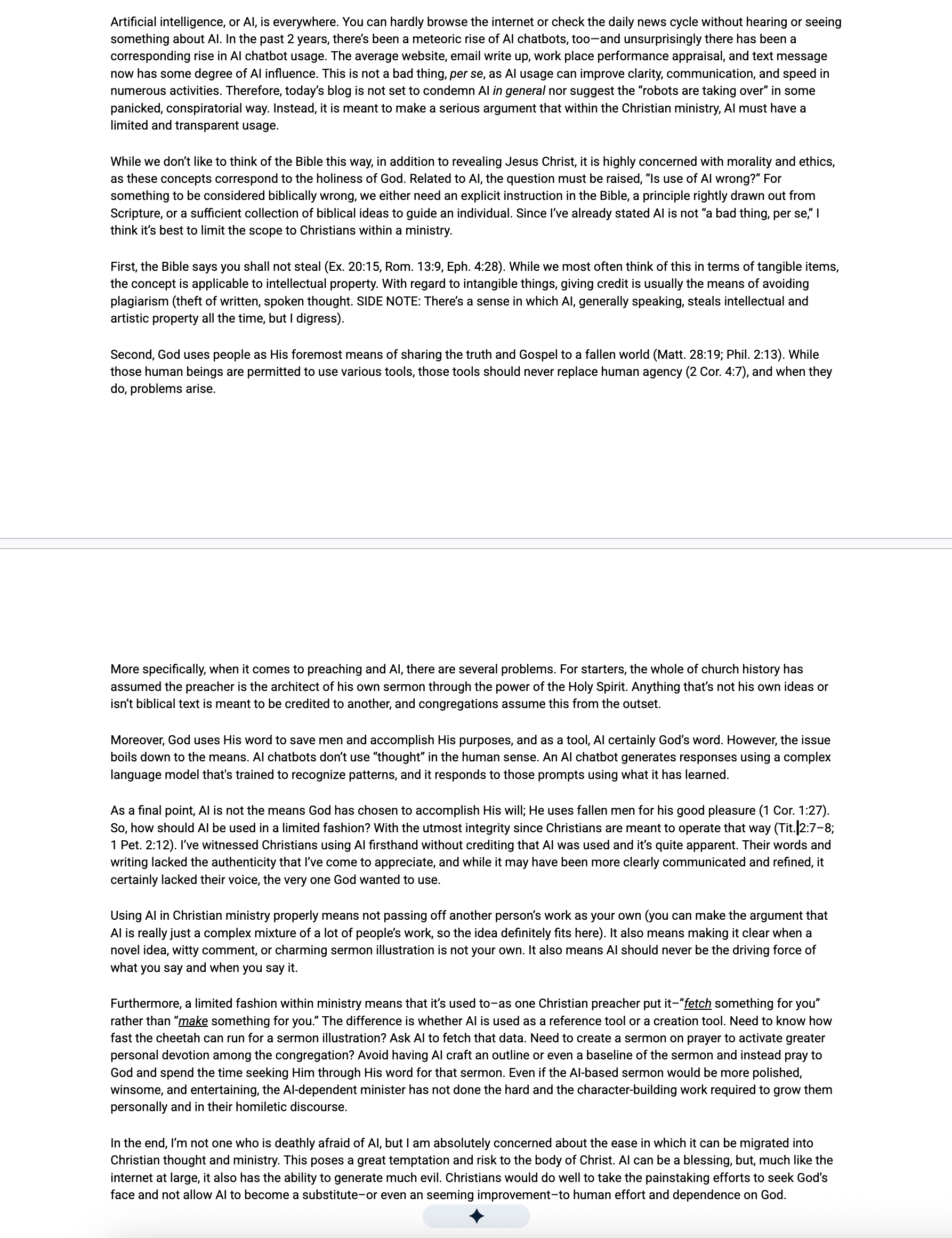
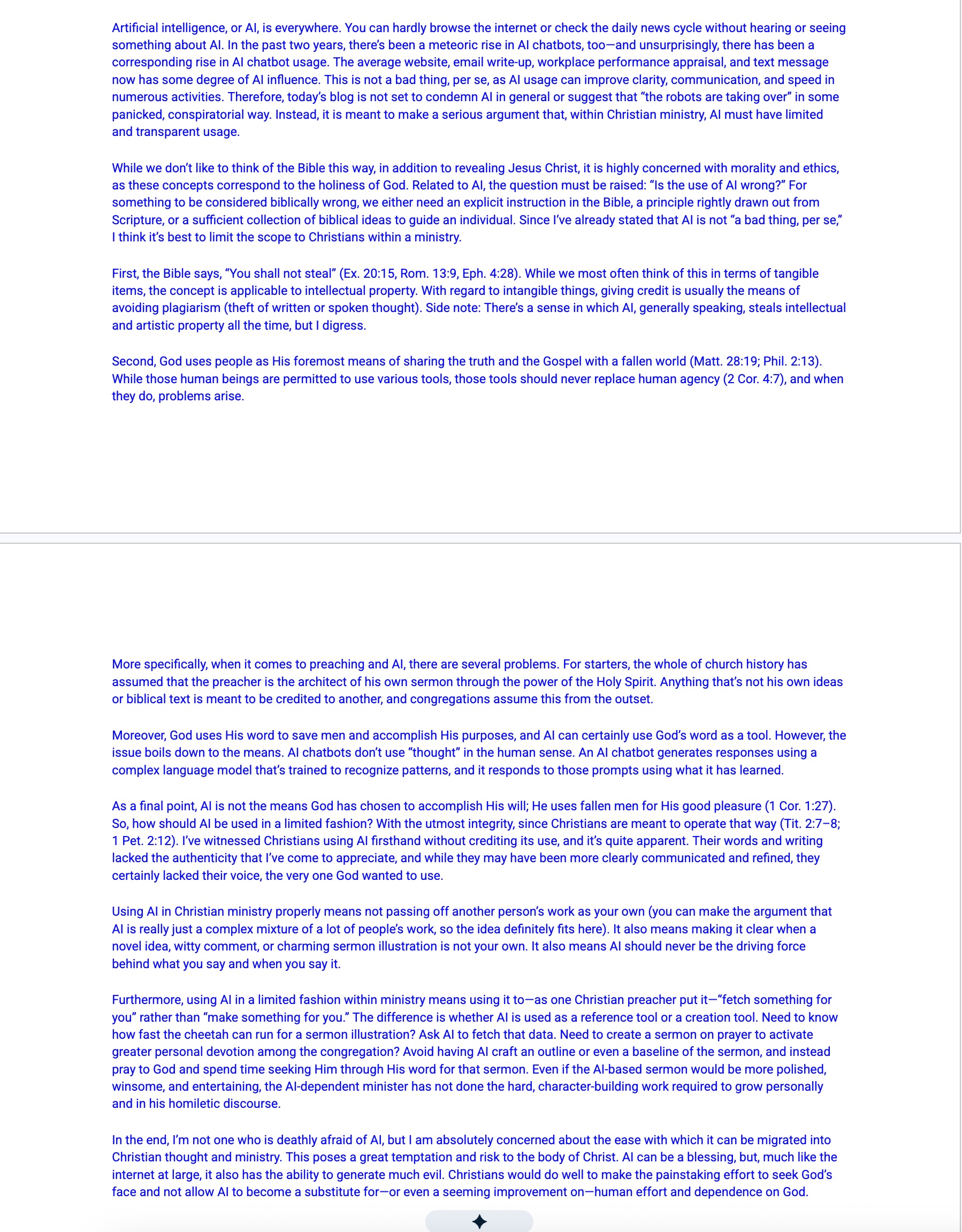
As an example of using AI in a limited fashion, after having my daughter review this editorially, I ran this post through a chatbot purely as a “double-check.” To show the extent of the changes, I’m sharing a picture below of the “before” and “after” (blue font) as well as my AI prompt for editing blog posts. You may notice minor additional editing in the final post above. Those were based on final edits I made upon a review after the chatbot edits.
AI Chatbot Prompt: You can only make changes that are NEEDED for clarity and spelling/grammar, but all changes must be summarized clearly and briefly at the end. This prompt only seeks for you to act as an editor, and your primary changes should be for grammar and spelling (e.g., using “their” vs. “they’re,” leaving out an Oxford comma, or spelling a word incorrectly), but you can recommend adjusting sentence location for flow. There should be no “happy” to “glad” type changes. Again, this is my writing. Changes must be insubstantial. You are also allowed to ask questions if something is important to clarify or if my writing doesn’t make sense.